
How Long Can You Leave a Yorkie Alone? Age Guide & What Helps
9 min read
Category Life with Pets
How long a Yorkie can comfortably stay alone depends on age, health, toilet needs, and experience. If your work or caring responsibilities keep you away, a suitable walker, sitter, or trusted helper can make a workable routine possible.
This guide covers realistic time limits by age, what to set up before you leave, and the difference between a bored Yorkie and one with separation anxiety.

Table of Contents
Realistic Time Limits by Age
The bladder is the hard limit for puppies. For adults, the limit is usually comfort and company, not just toileting.
- 8–12 weeks: 1 hour while awake, plus a night stretch only if she is crated beside you
- 3–4 months: 2 to 3 hours
- 4–6 months: 3 to 4 hours
- 6–12 months: 4 hours is a sensible daytime maximum
- Adult (1–8 years): 4 to 6 hours, not every day if you can avoid it
- Senior (8+): often closer to 3 to 4 hours, especially if she drinks more or has joint pain
These are ceilings, not targets. A Yorkie left at the maximum every weekday will usually start to show it: accidents, barking, chewing, or a frantic greeting when you walk in.
If you are still working on house training, use the shorter number for her age. A trained adult can last longer than a puppy who has not yet learned the door is the toilet.
Why Yorkies Handle Alone Time Poorly
- Tiny bladder. She is not being dramatic. She physically cannot hold on like a Labrador
- Low body fat and fast metabolism. Puppies in particular can drop blood sugar if a meal is delayed. See Yorkie hypoglycemia if she is still very small
- Bred to work beside people. Isolation is the opposite of the job they were designed for
- Cold when still. A Yorkie left on a hard floor in an empty room often starts shaking from temperature, not fear
- Noise sensitivity. A letterbox, a neighbour, or a passing truck can set off alert barking that lasts the rest of the afternoon
None of this means she can never be left. It means the setup has to do more work than it would for a larger, more independent breed.
What to Set Up Before You Leave
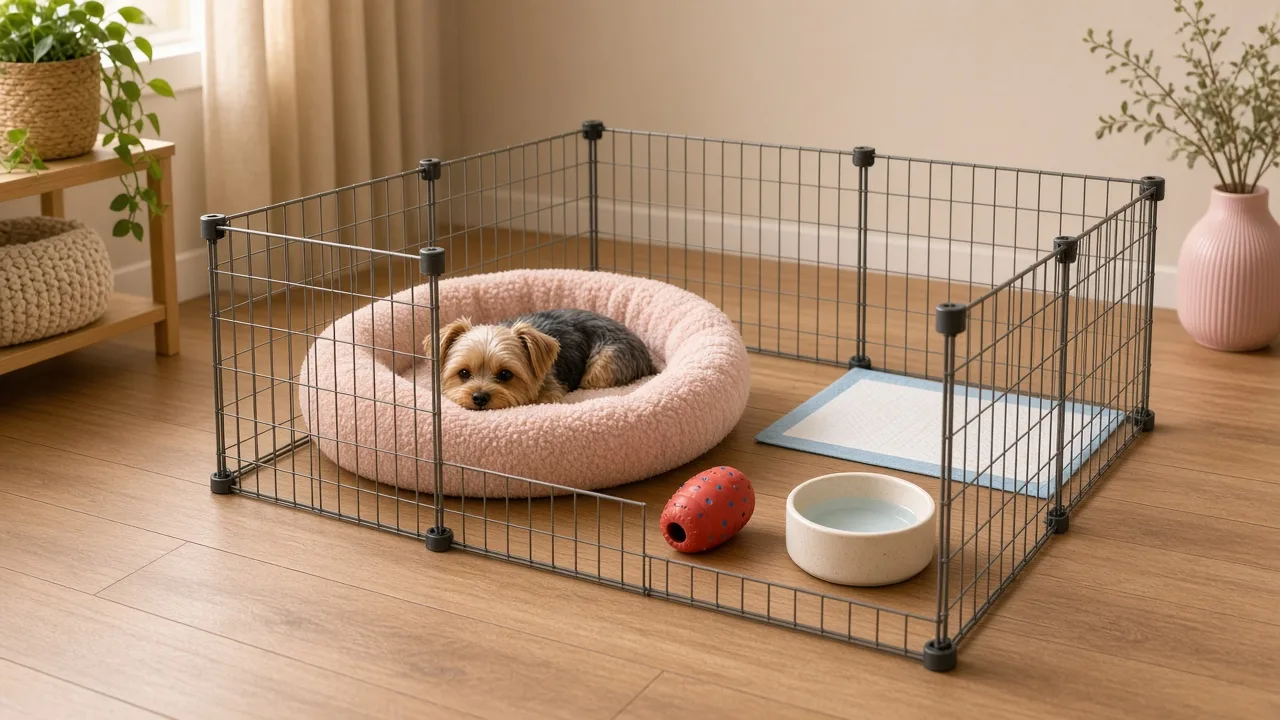
- A defined space, not the whole house. A playpen or a puppy-proofed room keeps her from toileting in a distant corner you will not find
- Water she can reach the whole time. Do not withhold water to reduce accidents
- A toilet option if you will be gone longer than her interval: a pad or indoor grass tray in one fixed spot
- Something to chew that is safe if swallowed in pieces. A stuffed Kong with a smear of xylitol-free peanut butter occupies more time than a squeaky toy
- A warm bed off the floor. A jumper or a covered crate takes the chill off
- White noise or a radio if she startles at hallway sounds
- A camera if you can. You need to know whether she settles after ten minutes or cries for two hours
Feed her before you leave, then take her out to toilet. The most common accident window is the first half hour after a meal, which is exactly when many people shut the door and go.
Crate, Playpen, or Free Roam
A crate is useful if she already sees it as a bedroom. It is a bad plan if you only shut her in when you leave. She will pair the crate with abandonment.
A playpen is usually kinder for daytime absences: room for a bed, a pad, and a toy, without the run of the house. Free roam only works once she is reliably house trained and not destructive.
Never use a crate as punishment, and never leave a collar she can catch on the bars. If you need the crate for potty training, practise short, boring stays while you are still in the house first.
Separation Anxiety Versus a Bad Routine
A Yorkie who is simply under-exercised will often settle after a burst of noise. Separation anxiety looks different:
- Drooling, panting, or trembling as you pick up keys
- Persistent howling or scratching at the door, not a few alert barks
- Destroyed door frames, blinds, or her own paws
- Accidents in a dog who is otherwise trained, especially near the exit
- Refusing food you left, then eating the moment you return
If that is the picture, longer absences will make it worse. Shorten the time, stop making departures dramatic, and practise leaving for one or two minutes, then five, then ten. Reward calm, not the frantic reunion.
A tired Yorkie handles alone time better. A short walk and a few minutes of training before you go out is more useful than an extra toy. How much exercise a Yorkie needs covers what is enough without overdoing joints and trachea.
When You Need Help, Not a Longer Workday
If your job is a standard office day, a Yorkie is a two-person problem or a paid-help problem. A midday dog walker, a neighbour, or daycare two or three days a week is more realistic than hoping she will "get used to it."
Puppies under four months should not be left for a full workday at all. That stage is covered in the new Yorkie puppy checklist.
Frequently Asked Questions (FAQ)
Can I leave my Yorkie alone for 8 hours?
Not as a regular habit. An adult may physically hold it that long once or twice, but most will toilet, bark, or become anxious. Arrange a midday break.
Can Yorkies stay home alone overnight?
Overnight is usually easier than a workday because she is asleep, but only if she is house trained and the space is safe. Puppies still need a night trip.
Is it cruel to crate a Yorkie while I am out?
Not if the crate is the right size, she has been taught to like it, and the time is short. It is cruel if she is left in it for a full workday or only put in when you leave.
My Yorkie screams when I leave. Will she grow out of it?
Some puppies settle with a better routine. True separation anxiety does not fade by being ignored. Shorten the absences and get a trainer or behaviourist if it is escalating.
Should I leave the TV on?
It can help if she startles at outside noise. It will not replace company, and a loud action film is not calming. A talk radio station or a familiar playlist is enough.
Disclaimer: This article is for informational purposes only and does not replace professional veterinary or behaviour advice. Sudden accidents, collapse, or extreme distress when left alone should be checked by a vet.