
Why Do Cats Knock Things Over?
7 min read
Category Life with Pets
Tag cats
The glass was not in the way. The cat moved it anyway, watched it fall, and looked at you as if the experiment had been a success. She is not trying to ruin the table. She is doing what a hunter's paws are for: testing whether a thing moves, and then whether you do.
Most of this is normal. Some of it is boredom with a receipt. Almost none of it is fixed by telling her off after the crash, which she will file under "the crash works."
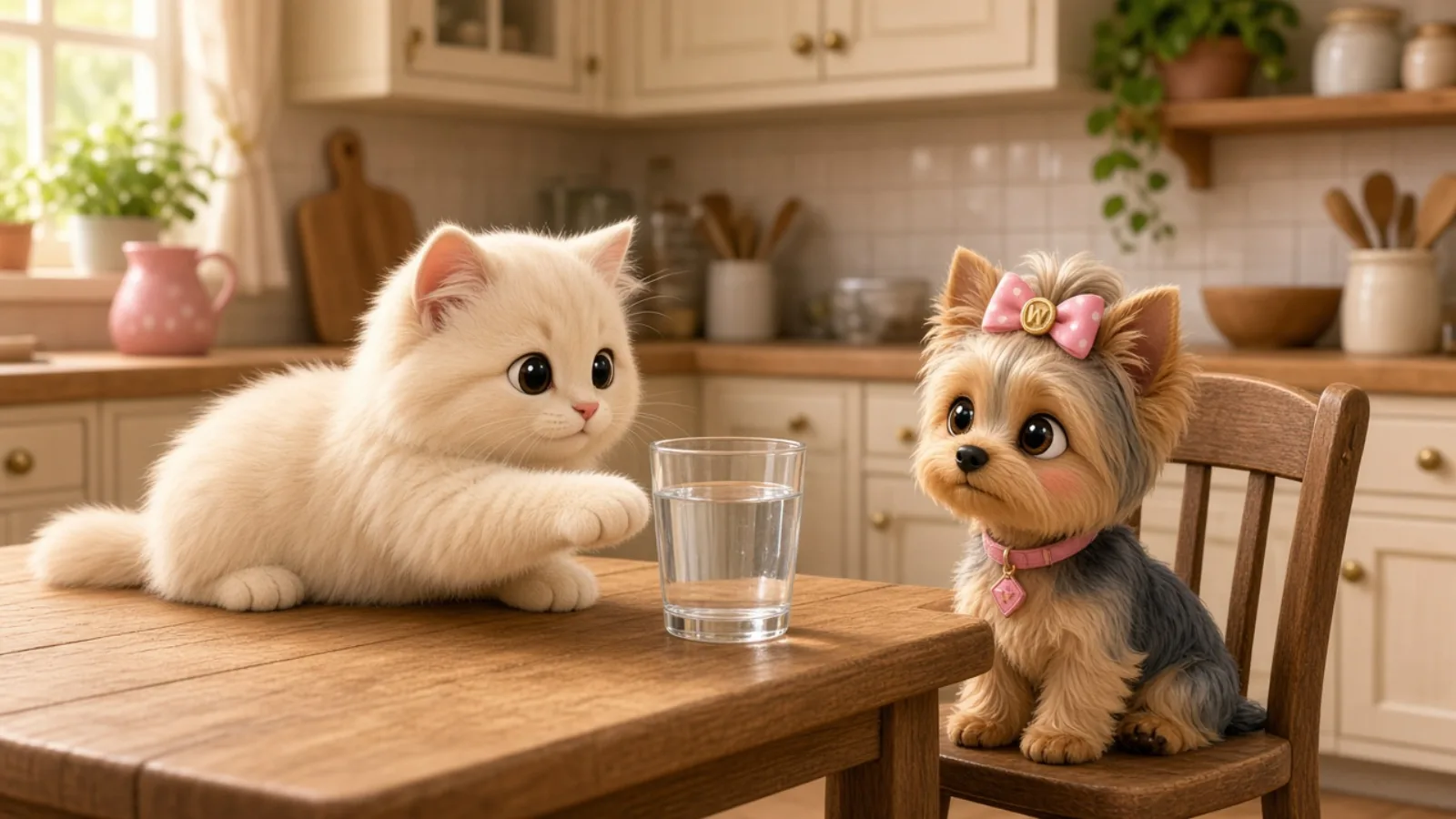
Table of Contents
Their Paws Are How They Ask Questions
Cats investigate with their mouths less than dogs do, and with their paws more. A pat tells her the weight, the slide, and whether the object fights back. A pen that rolls is interesting. A pen that falls and makes a person appear is a jackpot.
This is the same curiosity as kneading, aimed outward instead of into a blanket. Kneading says the place is safe. Swatting says the object might be prey, a toy, or a button that summons staff.
Kittens do it because everything is new. Adult cats do it because a quiet house still contains unsolved objects, and because gravity has never once been boring.
Attention Is a Powerful Treat
If the fall produces a gasp, a lecture, or you getting up to check, the behaviour paid. Cats do not require the attention to be affectionate. They require it to happen. A person who is busy on a laptop is a particularly tempting experiment, because the baseline is silence and the result is a reaction.
You can see the pattern: she looks at you, looks at the object, then commits. That glance is the tell. She is not absent-minded. She is running a test you have already graded.
Hunting With No Hunt
A cat who spends the day alone indoors still has a hunter's day to fill. When nothing squeaks, the water glass will do. Dawn and dusk are prime time, which is why the mug dies at 6am and not during the meeting you would have preferred to ruin.
Play that imitates a hunt, before she invents one, removes a lot of the motive. A wand toy, a short chase, a catch she is allowed to "kill," then a meal. Ten minutes is plenty. An hour of you dragging a string while answering email is not better. End while she is still interested, so the next session is worth waking up for.
Cats versus dogs is the longer version of this bargain: a cat can be alone, and she still needs a job inside that alone.
How to Keep the Table and the Cat
- Clear the edge. Anything precious, heavy, or glass lives a hand's width in from the drop. This is management, and it works better than character reform.
- Give the swat a legal target. A cardboard box, a sturdy track toy, or a ball in a rail on a side table lets the paw experiment without a casualty.
- Do not perform the aftermath. Pick up the mess later if you can, without a speech. If something dangerous broke, of course you deal with it. Do it quietly.
- Reward the pause. If she looks at the glass and does not touch it, a calm word or a toy tossed away from the table beats shouting.
- Add height that is hers. A cat tree by the window gives the "I affect the room" urge somewhere that is not your laptop.
Sticky tape and unbalanced mats are a poor long-term plan. They annoy, they do not teach, and a determined cat treats them as enrichment.
When Knocking Things Over Is a Health Clue
A cat who newly starts batting at everything, seems confused, cries, or misses the object she aimed at needs a vet. So does a cat who knocks things over while pacing, over-grooming, or unable to settle. Sudden behaviour changes can be pain, thyroid disease, high blood pressure, or vision trouble, especially in older cats.
Hunger can look like mischief too. A cat who raids the counter at the same time every afternoon may be on a feeding schedule that does not match her. Splitting meals, or a puzzle feeder, is a fair experiment after a vet has ruled out weight and health problems. Do not free-feed a cat who is already rounding out. Do not starve the experiment either.
If she is swallowing what she knocks down — hair ties, earplugs, floss — that is no longer a personality. String and elastic can bunch in the gut. Vomiting, hiding, or not eating after she may have swallowed something is urgent.
Frequently Asked Questions
Are some breeds worse?
Active, nosy cats do it more. That includes a lot of Bengals, Siamese-type cats, and any kitten. A quiet adult who has a window and a toy still might sacrifice one pen a week. Breed is a hint, not a verdict.
Should I spray her with water?
No. You will teach her that you are unpredictable, and she will wait until you leave the room. The glass still falls. You just stop being invited to the trial.
Why does she only do it to my things?
Because you react, or because your things sit where she already likes to be. The mug on a desk you occupy is a better button than a mug in an empty room.
Disclaimer: This article is general information, not veterinary advice. A sudden change in behaviour, or a cat who may have swallowed string or elastic, needs a vet.